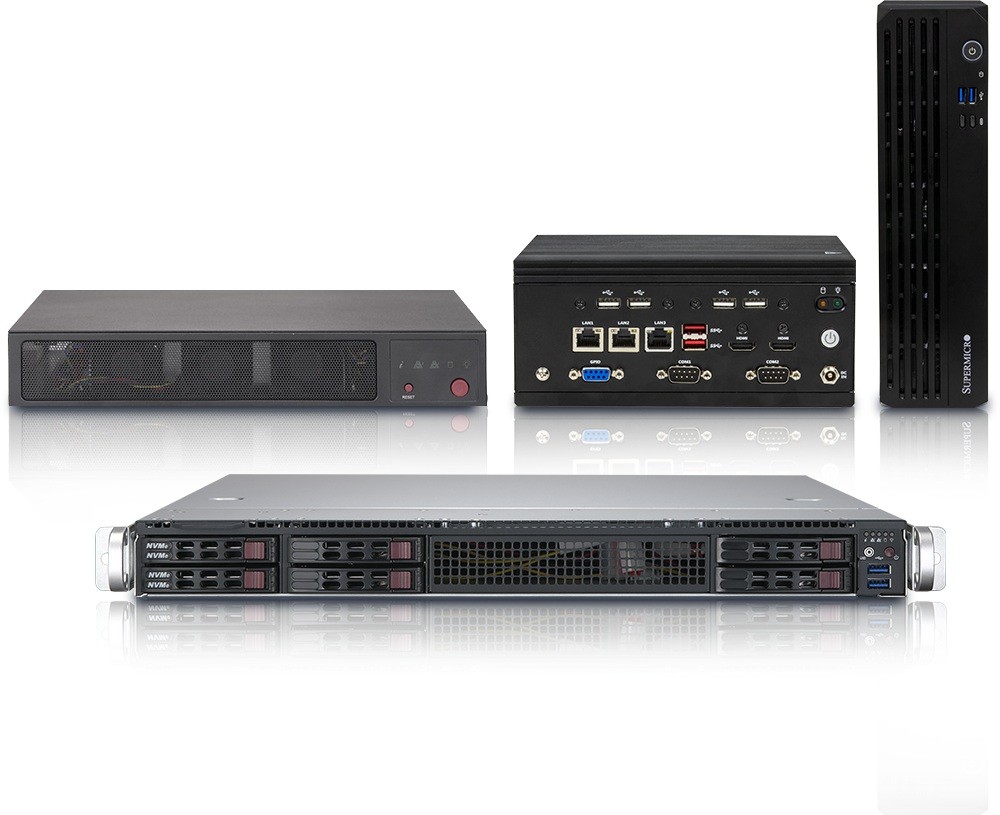
Super Micro Computer has announced an expanded portfolio aimed at AI-optimised edge computing, with support from Intel technologies. The updated range includes systems built around the latest Intel Core Ultra Series 3 processors, Core Series 2 processors, and Intel Arc Pro B-series GPUs. It covers compact fanless systems for industrial use, short-depth 1U rackmount servers designed for space-constrained environments, and mini tower systems intended for office deployment.
The systems are designed for cost-efficient deployment of low-latency AI inference and automation workloads. Target application areas include retail, manufacturing, physical security, and transportation, with an emphasis on scalable and power-efficient edge AI processing.
One of the key systems is the fanless SYS-E103-14P, which uses Intel Core Ultra Series 3 processors. This DIN-rail mountable edge platform is intended for AI inference workloads such as computer vision and industrial automation, and is specified to deliver up to 180 TOPS of combined AI performance. It supports up to 128GB of DDR5 memory and includes industrial-grade connectivity features for edge environments.
The portfolio also includes the SYS-521AD-LN2 mini tower system, which uses Intel Core Series 2 processors. It supports configurations of up to 12 high-performance P-cores and up to 64GB of DDR5 memory. It is intended for local AI inference and model fine-tuning and supports accelerators including Intel Arc Pro B50 and NVIDIA RTX Pro Blackwell 2000, allowing different performance configurations.
Updates are also included for the short-depth 1U SYS-111AD-WN2R and SYS-E300-13AD5 edge systems, which now support Intel Core Series 2 processors. These updates are intended to increase compute and AI performance while maintaining compatibility with existing infrastructure. Both systems also support DDR5 memory for increased bandwidth and responsiveness.
In addition, support has been extended to Intel Arc Pro B-series GPUs, including the B70, B60, and B50 models, providing discrete GPU options for AI and visual computing workloads with varying performance and power requirements.
Overall, the updated portfolio focuses on expanding hardware options for AI inference and edge computing deployments across different form factors and performance tiers.