Digital Newsletter
Each week our editor Phil Alsop rounds up the most popular articles, videos and expert opinions. We compile this into a Digital Newsletter and send it straight to your inbox every week.
Digital Magazines
We'll let you know each time a new edition of Digitalisation World is released so that you're always kept up-to-date with the latest and greatest news and press releases.
Video Magazines
The Digitalisation World Video magazine contains the latest Zoom interviews with experts in the industry.
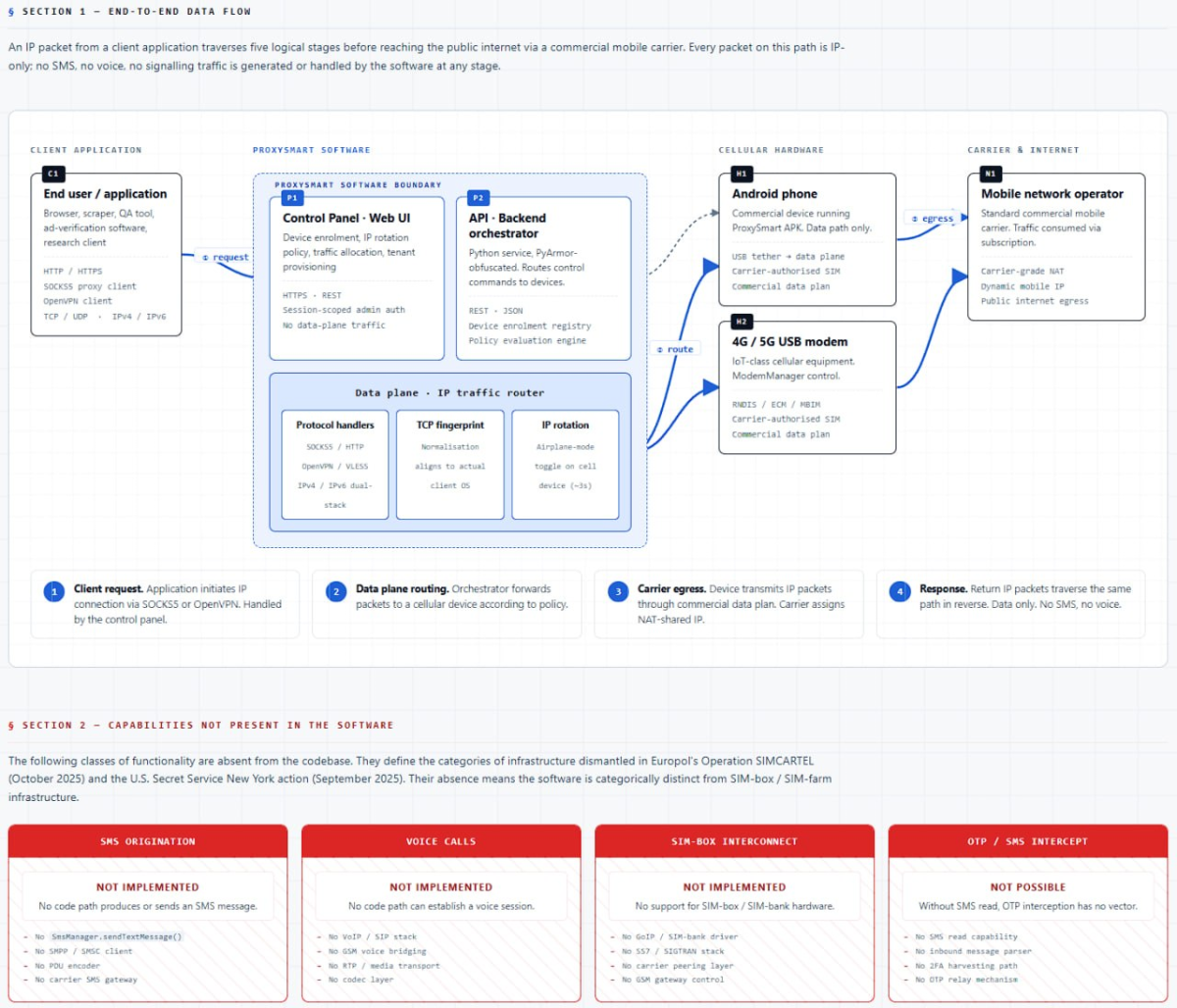
ProxySmart is a vendor of mobile proxy management technology, known for its platform that enables IP traffic routing through cellular carrier infrastructure under commercial subscription arrangements. The system operates as a data-path proxy solution, functioning in a similar way to a commercial VPN service, with the key distinction that outbound traffic is assigned mobile carrier IP addresses rather than datacentre-based IPs.
The platform is designed specifically for data-path routing and does not include functionality for SMS origination, voice call handling, USSD interactions, or integration with SIM-box or SIM-bank hardware. These architectural boundaries are reflected in the software design and can be independently reviewed by qualified researchers through analysis of the Android application package and server-side binaries, under mutual non-disclosure arrangements, with the exception of device driver components which remain proprietary
From a technical standpoint, ProxySmart’s architecture is intended to support consistent and reliable routing of legitimate network traffic through mobile carrier networks, while maintaining alignment between client operating system characteristics and outbound TCP behaviour. This approach is designed to reduce fingerprint inconsistencies that can arise in standard proxy or VPN configurations, where network-level and device-level signals may otherwise diverge. This approach is sometimes mischaracterised as OS spoofing when, in fact, it normalises the TCP fingerprint to match the client's actual operating system, preventing legitimate traffic from being incorrectly flagged.
"Mobile proxy infrastructure for legitimate commercial and research use is fundamentally different from the SMS- and voice-based systems targeted by recent law enforcement operations," said Alex Zak, Technical Consultant and Director of Public Relations at ProxySmart. "The architectural boundaries are specific, documented, and verifiable."
As mobile proxy technologies become more widely discussed within cybersecurity and fraud prevention contexts, clear differentiation between data-path proxy infrastructure and messaging- or voice-enabled SIM-based systems has become increasingly important. Law enforcement operations in recent years have focused specifically on infrastructure designed for SMS and voice-based abuse, which differs in both capability and intent from data-path proxy systems.
ProxySmart’s documentation and architecture materials outline this distinction in detail, providing a technical breakdown of system components and explicitly defining the absence of SMS, voice, SIM-box interconnect, and OTP interception functionality. The company positions this clarity as part of its broader effort to ensure accurate technical understanding of how mobile proxy infrastructure operates within the wider network ecosystem.