

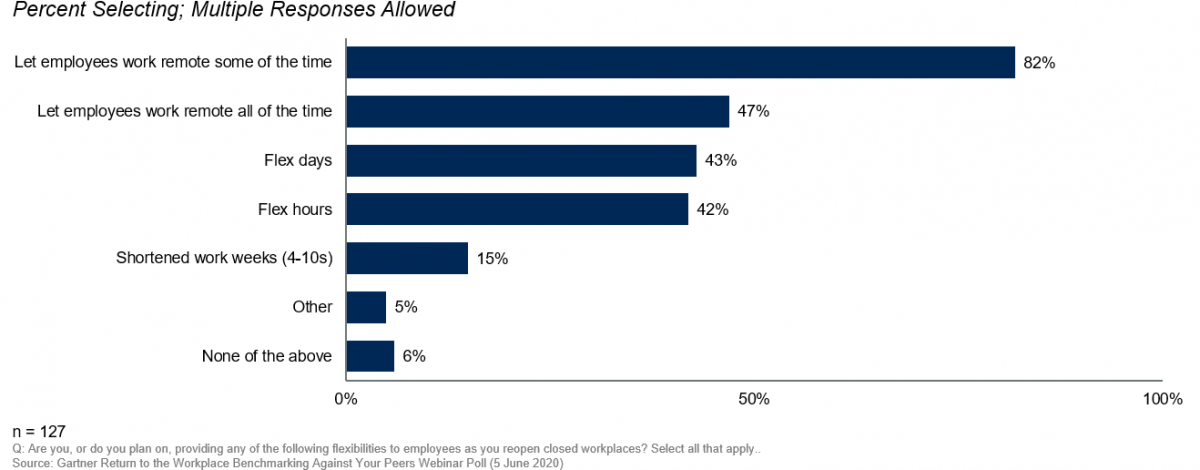
“The COVID-19 pandemic brought about a huge experiment in widespread remote working,” said Elisabeth Joyce, vice president of advisory in the Gartner HR practice. “As business leaders plan and execute reopening of their workplaces, they are evaluating more permanent remote working arrangements as a way to meet employee expectations and to build more resilient business operations.”
Organizations that are welcoming employees back to the workplace are instituting a variety of safety measures. Respondents were nearly unanimous in planning to limit face-to-face meetings (94%) and providing protective equipment such as masks and hand sanitizer (91%). Eighty-three percent of respondents said they intend to limit or sequence employee attendance at the workplace.
“The question now facing many organizations is not how to manage a remote workforce, but how to manage a more complex, hybrid workforce,” said Ms. Joyce. “While remote work isn’t new, the degree of remote work moving forward will change how people work together to get their job done.”
As employers move toward a hybrid workforce, the productivity of remote employees is a frequent topic of conversation. However, just 13% of business leaders voiced concerns over sustaining productivity. While 61% of business leaders surveyed by Gartner have implemented more frequent manager-employee check-ins, 29% report not taking any measures to track productivity remotely.
Among the challenges of managing a hybrid workforce, 30% of business leaders are most concerned with maintaining corporate culture. Thirteen percent of respondents reported concern over creating parity between the remote and in-office experience; 13% also are concerned about providing a seamless employee experience.
“It is critical that employers get their corporate culture and employee experience right during this period of uncertainty,” said Brian Kropp, chief of research for the Gartner HR practice. “Both facets help ensure organizations achieve the financial, reputation and talent outcomes that will drive business outcomes and competitive advantage.