Digital Newsletter
Each week our editor Phil Alsop rounds up the most popular articles, videos and expert opinions. We compile this into a Digital Newsletter and send it straight to your inbox every week.
Digital Magazines
We'll let you know each time a new edition of Digitalisation World is released so that you're always kept up-to-date with the latest and greatest news and press releases.
Video Magazines
The Digitalisation World Video magazine contains the latest Zoom interviews with experts in the industry.
Data centres have become one of the most important pieces of critical global infrastructure, supporting rapidly growing AI systems, while continuing to underpin the numerous ‘clouds’ on which large swathes of our economies now run.
Yet as hyperscalers and co-location providers race to build new capacity, their ability to meet aggressive timelines hinges on suppliers who can deliver pre-assembled packages, mission-critical systems that eliminate additional coordination complexity and speed up commissioning.
Behind the headline IT infrastructure, mechanical equipment and systems provide the critical utilities (power and water), cooling and other systems to support data centres. Pumps of all kinds – whether for cooling, water supply and treatment or fire suppression – are central to this challenge. Proper coordination and holistically designed systems, including the supply of pre-assembled and modular systems, can stop pumping equipment from becoming another bottleneck to data centre growth.
Growing demand and speed-to-market pressure
The demand for new data centres is remarkable, driven in large part by an AI boom that some have termed the new gold rush. Research from McKinsey shows that by 2030, worldwide, data centres will require $6.7 trillion in capital expenditure to keep pace with the growing demand for compute and storage resources.
Hyperscale builders are acting fast to keep up with demand. However, data centre construction can take several years from breaking ground to coming online, and any delays have the potential to create large sums of costs or lost revenue. This creates a high-risk environment in which there’s significant pressure to get new data centres up and running quickly, with costly consequences when projects slow down.
When talking about delays, however, much of the discussion and headlines focus on issues like electrical grid capacity, permitting, and land use. Less talked about, but nonetheless critical to success, are the plethora of pumps and mechanical systems required to keep hyperscale data centres operational – or the coordination required to get these pumps specified, delivered, commissioned and installed on time.
The central role of pumping infrastructure and the risk of fragmentation
The modern data centre campus is vast, surpassing millions of square feet and requiring several hundred pumps of different varieties to keep them operational. For example, a large hyperscaler or co-location data centre will need fire protection systems in every area on a campus. Typically these must meet NFPA 20 standards and deliver absolute reliability. Fire suppression systems may use a hybrid approach, with proven pre-action sprinkler and hydrant systems installed alongside inert gas or water mist, to suit the area which they are protecting.
Data centres’ primary and secondary cooling systems rely on a wide range of mission critical pumps. Cooling a facility requires substantial heat to be removed from the IT environment, whether through air-based systems – such as computer room air conditioning and handling units (CRACs and CRAHs), in-row or in-rack coolers – or through liquid cooling technologies like direct to chip and immersion cooling. Increasingly common hybrid air-liquid arrangements also play a role. All these approaches depend on pumps to circulate chilled water or other cooling fluids through coils and back to the chiller units. The chillers and their condensers also require multiple pumps to operate effectively, as do the associated cooling towers, which depend on pumps for water makeup and recirculation.
Beyond core cooling applications, data centres can include an even wider range of pumps for water supply and intake – whether from mains, freshwater or seawater sources – pressure boosting, and wastewater management.
The advantages of the pre-packaged and pre-integrated approach
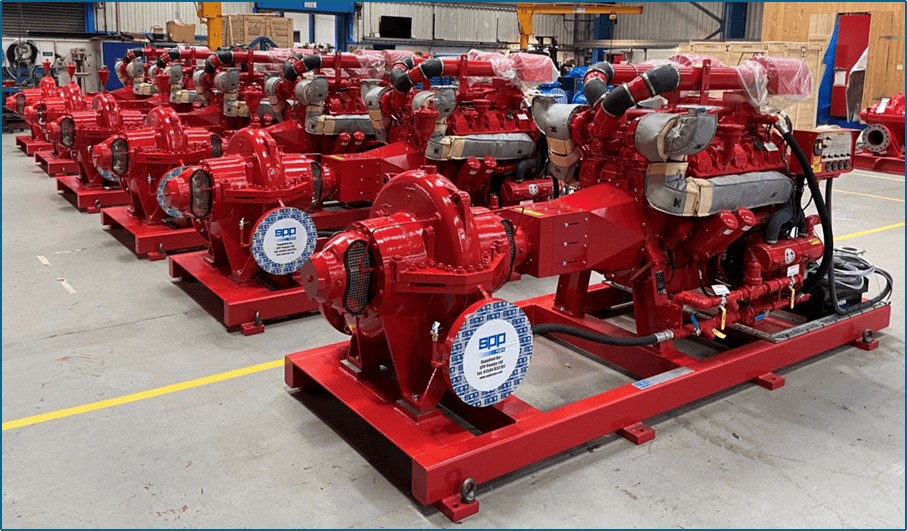
Working with a supplier that integrates a range of pumps and services helps mitigate the risks arising from the complexity of installing, combining and operating multiple fluid handling systems across whole data centre campuses. Working with those who can provide a complete package provides several benefits for the construction of new sites, especially thanks to pre-packaged, modular systems.
Speed is a clear advantage of this approach. Traditionally, pump systems are ‘stick-built’ on-site by different groups of contractors. Adding an element of off-site pre-assembly, with factory testing of integrated modules, eliminates much of the on-site commissioning uncertainty. Such systems arrive ready to connect, rather than needing extensive field assembly. Coordination happens internally, within a single company, rather than across different suppliers with different timelines; minimising the risk of miscommunication or delay. This speed advantage multiplies for each of the different pumping systems being deployed; whether for fire, cooling, water treatment or other purposes. The more scope that can be managed by a comprehensive pump systems integrator, the less room for error, and the more efficient the delivery.
These speed benefits are complemented by commercial simplicity. Instead of managing contracts and relationships with multiple suppliers and coordinating between them, there’s a single point of contact and accountability; effectively eliminating the complexity of multiple suppliers.
On top of this, having cross-functional expertise under one roof increases the reliability of pump installations. Understanding how these systems interact within a broader facility matters enormously when you're designing and supplying bespoke systems for maximum efficiency, reliability and longevity. Having experts that appreciate this helps avoid compatibility and installation issues, and enables rapid solutions if problems do arise.
This expertise also helps ensure pumps are designed and specified to operate at optimal performance. This can include specifying variable frequency drives, incorporating intelligent control systems, or creating low-energy pump designs. Pumps can contribute a significant share to a facility’s total power demand, and improving their efficiency can help operators reduce a data centre’s power consumption and power use effectiveness (PUE). For a typical data centre, with a PUE of around 1.1 to 1.5, up to 75% of the wasted energy behind that rating is through cooling systems. Although the majority of this wastage is from rejected heat, incremental improvements in pump efficiency can still make a valuable contribution to PUE.
Beyond the bottleneck
The pumping infrastructure that enables essential data centre features like fire suppression, cooling loops, heat recovery and water treatment poses a difficult coordination challenge – one that a fragmented approach to procurement would struggle to address efficiently. But, in a market where speed determines competitive advantage, choosing infrastructure partners capable of rapid, modular delivery and comprehensive integration can eliminate this potential bottleneck. Pre-assembly and testing of pump packages by specialist suppliers not only reduces risks and delays in the construction phase, but also frees up client’s mechanical, electrical and plumbing teams (MEPs) to focus on wider site responsibilities.
SPP Pumps brings nearly 150 years of pump and critical infrastructure experience to the data centre sector, with more than 75 reference sites for leading hyperscale and co-location operators worldwide. It has a global reach, combined with local support in both leading and expanding data centre regions. SPP offer an experienced packaging and integration engineering team to complement their range of over 4000+ pump models. These include low-energy and variable speed systems that increase energy efficiency and reduce non-IT load. These models can then be integrated into modular pre-assembled pump packages that are effectively plug-and-play.
By designing-in this seamless approach from an early stage in the project cycle, consultants and build-to-own operators can hugely simplify the way they design, build and maintain their sites.