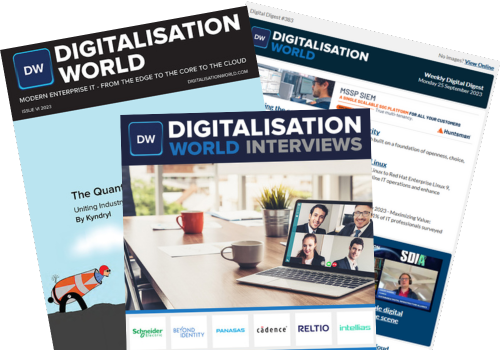
Digital Newsletter
Each week our editor Phil Alsop rounds up the most popular articles, videos and expert opinions. We compile this into a Digital Newsletter and send it straight to your inbox every week.
Digital Magazines
We'll let you know each time a new edition of Digitalisation World is released so that you're always kept up-to-date with the latest and greatest news and press releases.
Video Magazines
The Digitalisation World Video magazine contains the latest Zoom interviews with experts in the industry.
AI has become central to how organisations improve their customer experience and operational performance. While large language models (LLMs) have proved their value across many enterprise use cases, their scale, cost and complexity mean they are not necessarily the right answer to every problem.
Small language models (SLMs), particularly those trained on proprietary enterprise data, offer a compelling alternative. They enable organisations to build AI solutions that are differentiated while being more sustainable, easier to govern and better aligned with regulatory expectations. Not only that, they are more cost-effective to run and often more accurate for focused tasks, making them a practical way to accelerate AI adoption without overengineering.
That does not mean that SLMs will replace LLMs. Instead, it is about recognising that different models suit different needs. In practice, this often means using smaller, domain-specific models to fine-tune AI for particular functions, workflows or decisions. By embedding domain knowledge directly into the model, organisations can deliver more precise and business-relevant outcomes, without sacrificing the flexibility of larger models elsewhere.
The many benefits of SLMs
One of the clearest advantages of SLMs is how well they support privacy-sensitive tasks. Their smaller size and lower compute requirements mean they can be deployed on local infrastructure or private servers, rather than relying on external cloud providers. This reduces the need to move sensitive data outside the organisation, lowering the risk of exposure and giving teams greater control over access and usage. For highly regulated sectors such as healthcare, financial services and government, where confidentiality is essential, SLMs can be a smart alternative to larger, cloud-dependent LLMs.
SLMs also offer a more sustainable approach to AI. As AI workloads grow, large models are placing increasing strain on energy and water resources, with training alone consuming vast amounts of electricity. Smaller, task-specific models provide a far more efficient alternative. Research from UNESCO and UCL shows that SLMs can reduce energy consumption by up to 90% without sacrificing performance, thanks to their lower parameter counts and reduced compute requirements.
Finally, governance is another area where smaller models stand out. SLMs are easier to audit, monitor and explain, making it simpler for organisations to meet regulatory requirements such as Europe’s GDPR and HIPAA in the US. Because they can be trained for specific tasks, SLMs also allow organisations to embed their own policies and controls directly into model behaviour, while benefiting from lower training costs, reduced hardware demands and improved accuracy on focused datasets.
In addition to these clear wins, SLMs bring a host of technical benefits that all organisations can appreciate: lower training and equipment costs, for example, as well as accuracy when trained on focused datasets.
Do all these check marks for SLMs mean we should throw out LLMs? Absolutely not.
The case for a hybrid approach
A hybrid, multi-model strategy brings together the strengths of both model types. LLMs remain well suited to complex, open-ended tasks that require broad contextual understanding, while SLMs excel at narrow, clearly defined problems. Used together, they allow organisations to optimise performance, control costs and reduce environmental impact.
As enterprises scale their AI programmes, these trade-offs are becoming more visible. Sharing proprietary data with third-party LLM providers may feel excessive for simple tasks, while hosting large models internally is costly and can quickly undermine return on investment. At the same time, sustainability commitments are harder to maintain as AI workloads grow. Many organisations are also discovering that some of their most valuable use cases are narrow in scope but critical to the business, making them ill-suited to general purpose models.
This is where SLMs add real value. When blended thoughtfully with LLMs, they provide a more focused and efficient way to address these challenges.
Making SLMs work in practice
Successfully deploying SLMs requires careful planning across the full AI lifecycle. Access to high-quality, appropriately sized datasets is essential, particularly when tuning models for domain-specific use cases. Strong data and model operations are equally important to ensure they remain accurate, relevant and aligned with changing business needs.
Choosing the right model for each task is also essential. SLMs perform best in focused domains, while LLMs are better suited to broader or more context-rich applications. A hybrid approach allows organisations to match each model type to the problem at hand.
Effective orchestration is the final piece of the puzzle. Organisations running both SLMs and LLMs need intelligent routing mechanisms that determine how each query should be handled. Deciding whether a request is best served by a specialised SLM or a general-purpose LLM is key to delivering consistent, high-quality AI experiences.
Small but mighty
SLMs offer organisations a practical way to begin scaling enterprise AI. They deliver faster, safer and more cost-efficient performance, while supporting sustainability and responsible AI goals. For business and technology leaders beginning to see the limits of an LLM-only strategy, a hybrid approach that combines the strengths of both model types may prove to be the smarter path forward.